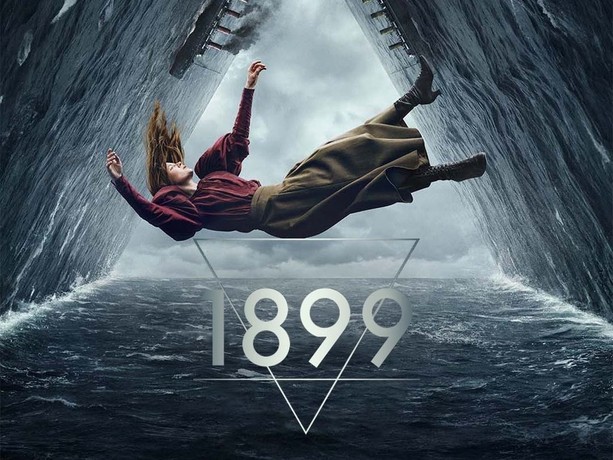
1899
Season 1
Season 1 premiered on Netflix on 17 November 2022 and consists of eight episodes. It follows the steamship Kerberos as it carries a multilingual group of European migrants from London to New York in the autumn of 1899. Four months earlier, the Kerberos's sister ship, the Prometheus, vanished without a trace. When the Kerberos receives a distress signal, Captain Eyk Larsen (Andreas Pietschmann) changes course and the passengers discover a single survivor aboard the derelict vessel: a mute boy clutching a small pyramid.
Back on the Kerberos, the atmosphere curdles. Passengers begin reliving their most traumatic memories, a green beetle appears that can open any locked door, and a man calling himself Daniel Solace (Aneurin Barnard) slips aboard from the Prometheus. The ship's compass spins wildly, a suffocating fog rolls in, and a mutiny erupts among the crew. Maura Franklin (Emily Beecham), a neuroscientist searching for her missing brother Ciaran, realises the letters that drew each passenger aboard were identical — and that everyone shares the same recurring nightmares.
As the layers peel back, the truth becomes stranger than any ghost story. The Kerberos and the Prometheus are not 19th-century steamships at all but constructs inside a vast simulation, and the real occupants are the crew of a space station drifting in the year 2099. Maura herself designed the experiment to keep her dying son, Elliot, alive inside a perfect loop; her father, Henry Singleton, is trapped within it too. The season ends as a vortex swallows the Kerberos and it reappears in a graveyard of identical wrecks, with Eyk staring across the water at another version of his survivors — the cycle ready to begin again. According to Variety, Netflix cancelled the series on 2 January 2023, before any of this could be resolved.
The Ending
The Wake
Maura stands at the heart of the machine, one hand on the key that controls the loop. The boy — Elliot — watches her from the doorway, no longer silent, no longer a child-shaped mystery but her son, whole and waiting. Behind him, Daniel does not reach for a weapon. He simply nods, the way he always did when he trusted her to make the impossible choice.
"You built this to keep me," Elliot says. Not an accusation. An observation, the way only a child who has lived inside a thousand versions of the same afternoon can make it.
"I built it because I couldn't say goodbye," Maura answers.
The Door
She thinks of Henry, still circling in his own corner of the simulation, certain he was the architect when he was only another prisoner. She thinks of Eyk, who has drowned and woken and drowned again, certain each time that this voyage would be the one that reached New York. She thinks of every passenger who climbed aboard the Kerberos believing they were escaping their old lives, when really they were volunteering for a kinder one.
Maura turns the key.
The simulation does not collapse. It opens. One by one the passengers feel the tug — the same pull that had always meant death, now meaning release. Tove sets down her burden. Krester finds his sister. Ling Yi and Yuk Je walk out of the fog and keep walking, into light instead of water. They remember, all at once, and then they let go.
The Station
The real world is cold and white and shockingly quiet. Maura opens her eyes in a pod on the Prometheus station, year 2099, and the first thing she sees is Elliot's face through the glass of the adjacent chamber, alive, aged exactly as he should have been. Daniel's hand finds hers.
In the observation deck, Henry is already waking. For a long moment father and daughter say nothing; there is too much to apologise for and not enough language for any of it. So Maura does the only thing that has ever worked between them. She hands him the pyramid — the key he spent the loop chasing — and says, "It was never yours to hold. It was his."
Henry looks at Elliot, understands, and for the first time in longer than any of them can count, the simulation's architect weeps for the right reason.
Kerberos, One Last Time
They give the passengers a final voyage, because some goodbyes deserve a setting. The Kerberos sails clean water under a real sky. Eyk walks the deck without hearing voices. Maura joins him at the rail, and neither of them speaks of New York, because the destination was never the point — the company was.
At the rail's end, Eyk offers his hand. "Next time," he says, "we make it to shore."
"Next time," Maura agrees, "we're already there."
The station's lights settle to a low hum. The loop is closed, not broken — kept now as a memory rather than a cage. Somewhere in the quiet, a green beetle clicks once against the glass and is still.
This is not an official ending. It is a fan-written imagining of how 1899 could have concluded.
Frequently Asked Questions
Was 1899 cancelled?
Yes. Netflix cancelled 1899 after one season; co-creator Baran bo Odar announced the news on Instagram on 2 January 2023 (per Variety).
Why was 1899 cancelled?
Netflix gave no official reason. Reporting from The Standard and Variety points to softer-than-expected completion rates and high production costs; 1899 was the first Netflix series filmed entirely in a virtual production studio, making it unusually expensive to sustain.
How many seasons of 1899 are there?
One season of eight episodes, each roughly 50–62 minutes, released on 17 November 2022.
Does 1899 have a proper ending?
No. The finale reveals the ships are simulations aboard a 2099 space station and ends on a looping-cliffhanger. Friese and bo Odar had planned a three-season trilogy (per Wikipedia/Hollywood Reporter), so the story was left unresolved.