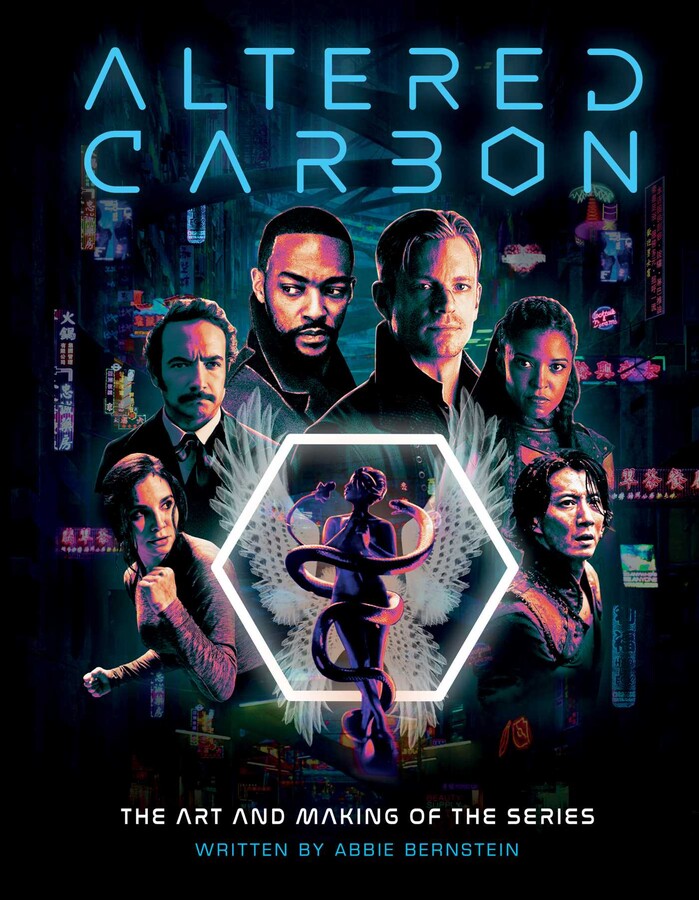
Altered Carbon
Season 1
Season 1 is set in Bay City (a renamed San Francisco), a neon-drenched metropolis where the sky belongs to the Methuselahs — the ultra-rich who live for centuries by swapping bodies — and the streets belong to everyone else.
Takeshi Kovacs (Joel Kinnaman), a former Envoy soldier and rebel, is taken from digital storage after 250 years. He is resleeved into a new body by Laurens Bancroft (James Purefoy), a Meth who claims his previous sleeve was murdered and he wants Kovacs to find the killer — since the needlecast backup of his consciousness was cut short before the kill. The deal: solve the case, earn freedom and enough money to disappear.
Kovacs assembles a fractured team. Detective Kristin Ortega (Martha Higareda), a CTAC cop whose corrupt boss killed Kovacs's original Bay City sleeve during a previous incident, distrusts him but is drawn into the mystery. Edgar Poe (Chris Conner), an AI who runs the Hotel Roe — modelled after Edgar Allen Poe's aesthetic — becomes Kovacs's loyal ally and emotional anchor. Vernon (Atoh Essandoh) joins them as a former military man whose daughter's cortical stack was destroyed by a Meth child who suffered no consequences.
The investigation weaves through fight clubs, AI brothels (where customers rent sleeves for pleasure), and a Quellist/Falconer resistance cell that still dreams of revolution. The Mett fleet above the city is loading a satellite called "The Elders" — a weapon that can wipe cortical stacks from orbit.
The killer is revealed to be Reileen Kawahara (Dichennna Lachman), Kovacs's sister from his original life. She was turned into a ruthless corporate operative over centuries by the Protectorate, and she staged Bancroft's murder to draw Kovacs out. The season culminates at the Head in the Clouds — a Meth pleasure palace — where Kawahara is apparently killed. But in a final twist, Bancroft — who was in on the scheme — has the needlecast system tampered with. Kovacs's stack is captured and he spends the next 30 years in a secret Protectorate prison while Bancroft takes the lunar colony escape pod he was promised.
Season 2
Season 2 picks up 30 years later. Kovacs (now played by Anthony Mackie) is freed from prison by Horashi, a legendary hacker who has been working against the Protectorate. Kovacs is pulled into a brewing rebellion on Harlan's World — a colony planet where the Protectorate's grip is weakening.
A rebel leader named Quellist Falconner (Renée Elise Goldsberry) is leading the uprising. But Quell is not entirely real — she is a construct, an AI reconstruction of the original Quellist (Kovacs's long-lost love), stored on corrupted cortical hardware. She carries Quell's memories but questions whether she is the real person or merely a copy. The Protectorate has been using Elder technology — ancient alien artefacts — to keep population control on Harlan's World, and Quell's rebellion is the only force standing against them.
Kovacs reunites with old allies and confronts old enemies. Trepe (Simonee Misseck), a rebel soldier; Tanaschita (Tanner Kynn), Kovacs's former lover who has since moved on; and Colonel Crow (Ian Tracy), a brutal Protectorate commander who has been torturing and resleeving resisting civilians for decades.
Kawahara is alive (of course — she backed herself up). She reveals that the entire Elder conspiracy goes higher than the Protectorate: the Elders are a race of beings whose technology can control consciousness itself, and the Protectorate has been using their artefacts to maintain immortality — not for everyone, but for the Meths who rule.
The season finale takes place in Elder space — an alien dimension reached through the core of the Elders' technology. Quell chooses to stay behind and reboot the Elder core, destroying the Protectorate's hold on the planet but sacrificing herself in the process — or so it seems. Kovacs wakes in the real world, Quell's body gone, and he walks off into an alien landscape alone — uncertain whether Quell's consciousness survived inside the Elder dimension.
The Ending
One Year After the Elder War
The sky above Harlan's World is pale orange at dawn. Not twilight — something wrong with the particulate after the Elder core destabilised and then restabilised. The scientists say it will clear in a generation. Takeshi Kovacs does not plan to be around that long.
He walks with Quellist Falconer through the ruins of the Protectorate's data centre — a mausoleum of shattered cortical stacks. Millions of backed-up minds, never restored. The Meths uploaded themselves as the facility collapsed, expecting rescue. None came.
"Do you feel it?" Quell asks. She is in a different sleeve now. Not Danesh Harlan's face, not something grand. A quiet body from someone who died in the war and donated their cortical stack to the cause.
Kovacs kicks debris across the cracked floor. "The quiet."
"The silence," she says. "No needles. No watching. No corporate envoys tracking every sleeve on the planet. For the first time in three hundred years, we are not being followed."
They step into a field of white grass. Native regrowth. The planet is healing.
The Edge of the City
They reach the outer perimeter of what was once the Protectorate government zone. Horashi rigged a transport before he disappeared — the prototype SVT needlecast ship, unregistered, uncorporated. An outlaw vessel for an outlaw afterlife.
Kovacs looks at the ship. Then at Quell. Then back at the ship.
"I have spent centuries running from Bancroft, Kawahara, and the Protectorate," he says. "Every sleeve I wore was a cage. Every planet I landed on was a war. I don't know how to do anything else."
Quell studies his face. "Then learn."
They climb into the ship. The engines hum to life. No destination programmed. No flight plan filed. No corporation tracking their departure.
The ship lifts off, rising through the pale orange atmosphere, above the corporate wreckage, above the Elder ruins, above the entire system that tried to own them.
For the first time in the history of interstellar humanity, Takeshi Kovacs and Quellist Falconer simply leave.
No credits. No contract. No one watching.
This is not an official ending. It is a fan-written imagining of how Altered Carbon could have concluded.
Frequently Asked Questions
Was Altered Carbon cancelled?
Yes, Altered Carbon was cancelled by Netflix after two seasons. The series premiered on February 2, 2018, and Season 2 was released on February 27, 2020. Netflix confirmed the cancellation in August 2020, citing high production costs and declining viewership from Season 1 to Season 2.
Why was Altered Carbon cancelled?
Altered Carbon was one of Netflix's most expensive series with reported budgets of $6-7 million per episode. Season 2 saw roughly half the viewership of Season 1, and COVID-era production complications made a third season even more expensive. A companion anime film, Altered Carbon: Resleeved, was released in 2020 but did not change the cancellation decision.
How many seasons of Altered Carbon are there?
Altered Carbon has 2 seasons with 10 episodes each (20 episodes total).
Does Altered Carbon have a proper ending?
Season 2 ends with Kovacs and Quell walking off into an alien landscape after defeating the Elder threat, but it was not intended as a series finale. Loose threads remain: Kawahara's fate, the Protectorate's star-wide control, and the broader rebellion against the ruling Meth class. Show creator Laeta Kalogridis has said she had plans for a third season continuing the rebellion.
What is Altered Carbon about?
Altered Carbon is set in a cyberpunk future where human consciousness is digitised on cortical stacks, allowing people to transfer between bodies ("sleeves"). The ultra-rich live for centuries by swapping sleeves while the poor die permanently. Takeshi Kovacs, a former Envoy soldier, is released from digital prison to solve a Meth's murder — and uncovers a conspiracy threatening the foundations of an immortal society. The series explores identity, class inequality, memory, and what it means to be human.